Port of Tallinn Personnel Strategy Futures Workshop
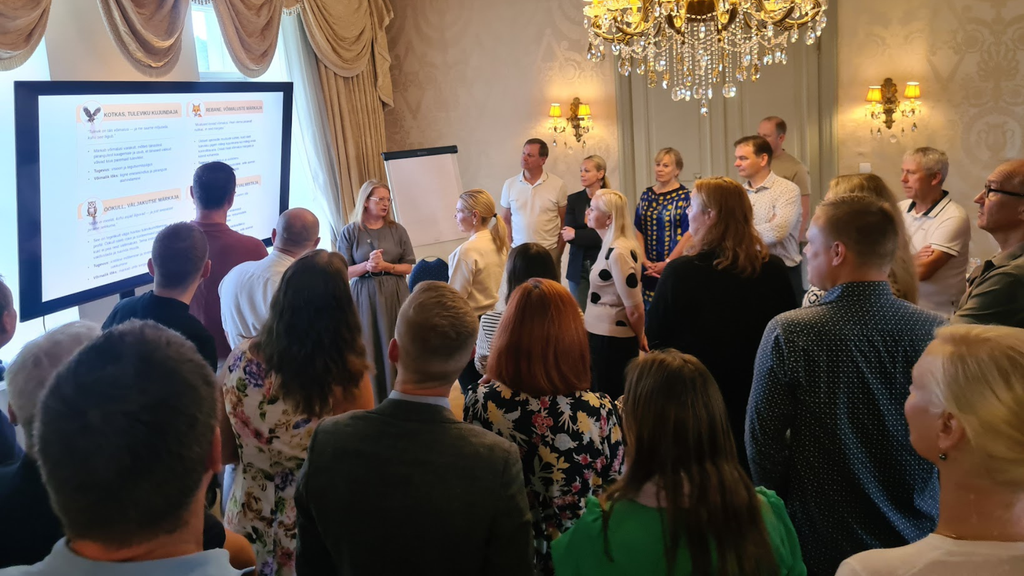
In August 2026, the Estonian Institute for Futures Studies facilitated a futures workshop at the Port of Tallinn’s leadership strategy day. The aim of the workshop was to explore how changes in work and labour markets may affect the Port of Tallinn’s future competence needs and personnel strategy. The workshop focused on alternative labour market futures, future competencies, and the strategic choices organisations can make today to better prepare for a range of possible developments.
What did we learn?
For the workshop, we developed four future scenarios for the Estonian labour market. The scenarios were built around two major uncertainties:
- Whether artificial intelligence primarily creates and amplifies new jobs or automates and replaces existing tasks.
- Whether the Estonian labour market remains relatively closed to international talent or becomes significantly more open and globally connected.
Different scenarios highlight very different challenges for organisations. In one future, the key issue may be a chronic shortage of skilled labour; in another, the rapid automation of existing roles. A third future may require managing highly international and technologically diverse teams, while a fourth may involve more fragmented forms of work and growing skills mismatches.
Across all scenarios, organisations need the capacity to identify how work is changing, develop new competencies, and adapt quickly to evolving labour market conditions.
Why did we take this approach?
The future of work is shaped by multiple developments whose direction and impact remain uncertain. Rather than relying on a single forecast, we used scenario planning to explore several plausible futures and their implications.
For the Port of Tallinn, it was important to connect broader labour market developments with the organisation’s own workforce and talent challenges. To achieve this, we combined horizon scanning and trend analysis, scenario planning, and future competencies mapping. This approach enabled participants to examine personnel strategy not only from the perspective of today’s needs but also through the lens of multiple possible futures.
By the end of the workshop, participants had developed a roadmap of milestones and strategic choices across key thematic areas, helping to clarify both future directions and actions that can be taken today.
Methods: Horizon scanning and trend analysis, scenario planning, future competencies analysis, and strategy stress testing.

