
PARE HR Strategist Development Programme
HR leaders work with people across the entire organisation while often serving as members of the executive team and contributing to broader strategic decision-making. This places HR professionals in a unique position to champion futures thinking within their organisations and support the implementation of meaningful change.
In early April, we contributed to the PARE HR Strategist Development Programme, organised by the Estonian Association for Human Resource Management (PARE), by delivering a two-day futures thinking module.
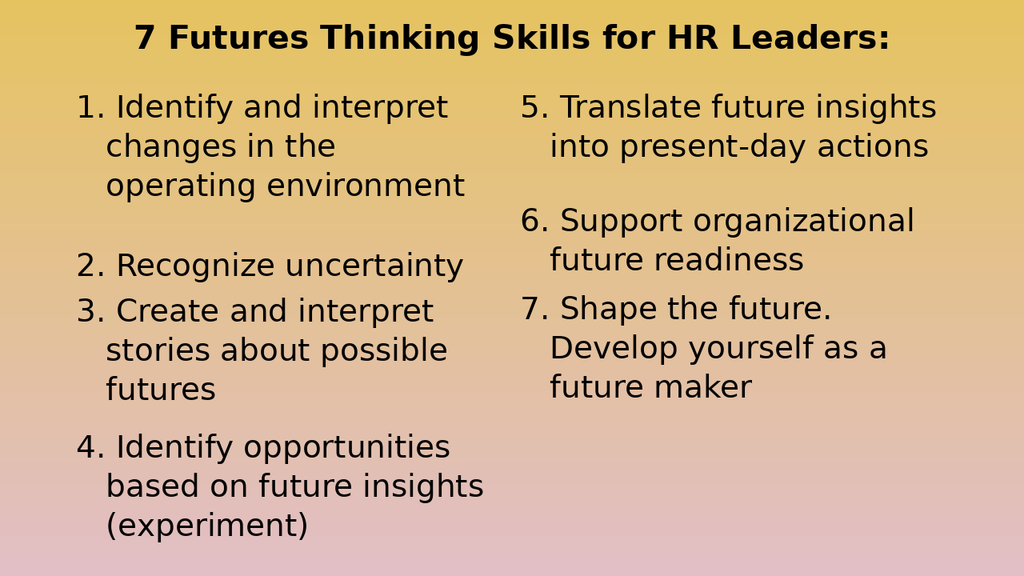
The training provided HR leaders with hands-on experience in applying futures and foresight methods. Participants learned how to identify changes in their operating environment, interpret signals and trends, and connect future-oriented insights with present-day HR decisions. The objective was to equip participants with practical futures thinking tools that they could immediately apply within their own organisations.
The four stages of futures thinking
The two-day module guided participants through four key stages of futures thinking.
1. Horizon Scanning
Participants mapped the megatrends and signals shaping the HR environment using the STEEPLE+V framework and collaboratively developed a trend radar.
2. Exploring Future Worlds
Participants worked through alternative scenarios describing different futures of work and labour markets. They examined how their organisations might perform and adapt under each scenario.
3. Insights
Scenario analysis encouraged participants to identify which changes appear inevitable, which developments require attention already today, and where the greatest uncertainties lie.
4. Decisions
Participants translated insights into action by formulating personal commitments, defining concrete steps they would take within their organisations to strengthen future readiness.
Throughout the programme, participants learned and applied a range of practical foresight tools, including:
- Futures Wheel
- Impact-Uncertainty Analysis
- Scenario-based SWOT Analysis
- Personal Action Planning Canvas
As a take-home assignment, participants analysed a signal of change relevant to their own professional environment and reflected on its implications for the future of HR.
Methods: Horizon scanning, trend analysis, STEEPLE+V analysis, scenario planning, Futures Wheel, impact-uncertainty analysis, scenario SWOT, and action planning.