
Youth Autonomy Scenarios 2050
How might young people’s autonomy and decision-making power evolve in Estonia by 2050? Commissioned by the Foresight Centre of the Estonian Parliament, we conducted the study “Youth Autonomy and Decision-Making Power in Estonia: Trends and Scenarios until 2050” (in Estonian). The central question was: what developments will shape young people’s independence, agency, and ability to meaningfully participate in society in the coming decades?
The study was based on the understanding that youth autonomy cannot be viewed solely through age thresholds, legal rights, or participation opportunities. Young people may have the right to vote, study, work, or express their opinions, but those opportunities are insufficient without support systems, self-confidence, knowledge, mental resilience, economic security, and a sense that their actions can make a difference.
“Agency and self-efficacy are often more important than age limits. The challenge is how to nurture and encourage participation continuously, rather than suddenly telling young people: now you may participate, so participate everywhere. The transition to independence should be gradual and supported, without overly abrupt shifts.“
– Mai Beilmann, Associate Professor of Empirical Sociology and contributor to the study
Key findings
The study’s conclusions clustered around four major themes.
1. The mental health crisis is limiting young people’s capacity for decision-making and independence
Deteriorating mental health among young people is becoming one of the most significant factors affecting their independence, decision-making ability, and participation in society. Estonia ranks among the European countries with the lowest indicators of youth mental well-being. At the same time, access to mental health services remains uneven and waiting lists are long, often preventing young people from receiving support when it is most needed.
Persistent security tensions may also shift public spending priorities away from long-term youth development and towards security-related expenditures. This could reduce investments in mental health, education, and opportunities that support young people’s autonomy.
2. Youth is becoming a longer and more uncertain transition period
Youth is neither a fixed nor universally defined life stage. Its meaning and duration are changing as educational pathways lengthen, labour market entry becomes more complex, and economic independence is achieved later in life.
A young person’s socio-economic starting point is becoming increasingly important. Independence depends more and more on access to employment, the cost of living, and family background.
3. Digital environments and artificial intelligence increasingly shape young people’s real autonomy
Digital environments are where relationships, work opportunities, participation, self-expression, and worldviews are formed. However, access to technology alone does not guarantee autonomy. Young people’s attention, information environments, self-esteem, and decisions may be strongly influenced by algorithmic systems.
The question is therefore not only whether young people can access digital tools, but whether they can maintain meaningful control over their choices and actions within increasingly complex digital ecosystems.
4. The risk of youthwashing: participation becomes more visible, but influence does not necessarily increase
Young people are becoming increasingly active in digital discussions, activism, volunteering, and civic engagement. At the same time, they remain underrepresented in many formal decision-making bodies.
Participation risks becoming symbolic if young people’s contributions do not have a clear path to actual influence. This creates the risk of youthwashing: involving young people to create the appearance of participation without genuinely sharing influence, responsibility, or decision-making power.
What did we do?
The project combined horizon scanning, trend analysis, and participatory scenario development.
First, we mapped trends and weak signals affecting youth autonomy based on scientific literature, policy documents, media sources, and international research. The analysis was conducted using the STEEPLE+V framework, covering social, technological, economic, environmental, political, legal, ethical, and value-related developments.
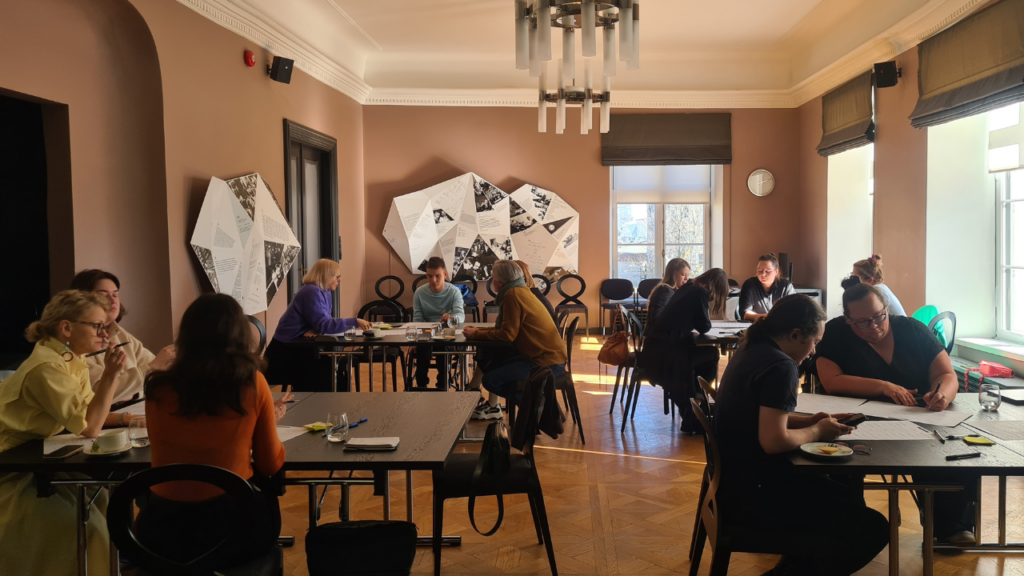
We then organised two online expert workshops and two scenario-building workshops involving young people, youth sector professionals, policymakers, researchers, parents, and teachers. In total, 34 participants contributed to the process.
Four scenarios for youth autonomy in 2050
The scenarios were built around two fundamental uncertainties:
- Whether institutions and support systems for young people can successfully adapt to rapid societal change.
- Whether autonomy becomes widely accessible or increasingly turns into a privilege reserved for those who already possess greater resources, support, and opportunities.
“A Well-Oiled Clockwork”
This scenario depicts an Estonia where support systems function effectively and autonomy is broadly accessible. However, a question emerges: does a highly organised and efficient system leave sufficient room for experimentation, risk-taking, and finding one’s own path?
“Every Young Person Is a Platform“
In this future, institutions are innovative and technologically advanced, yet autonomy increasingly depends on individual resources. Those with strong digital skills, supportive families, networks, and financial means can thrive, while others become more vulnerable.
“Solidary Self-Starters”
This scenario describes a future where public systems fail to keep pace with change, but young people create strong communities, networks, and alternative forms of learning and action. Autonomy emerges despite institutional shortcomings rather than because of institutional support.
“The Vicious Circle of Isolation”
The most concerning scenario portrays a future in which support systems stagnate and autonomy becomes the privilege of a small minority. Formal rights to participate still exist, but many young people no longer believe that they can influence society or change outcomes.
To make the scenarios more tangible, we also created fictional personas representing young people living within each future world.
What are the implications?
The study does not provide a single policy prescription. Instead, it highlights areas where policymakers may need to ask different questions.
Expanding access alone is not enough
Policies focused solely on educational opportunities, labour market measures, or participation mechanisms may leave some young people facing significantly greater risks when attempting to use those opportunities. Support networks, mental health services, and counselling systems remain equally important.
Mental health must be addressed across policy areas
Mental health is often treated only after problems have become severe. Greater attention should be paid to early warning signs in schools, youth work, and extracurricular education, while ensuring that young people can access support quickly and easily.
Digital literacy should be viewed as a core element of autonomy
Digital competence is not merely a technical skill. Young people need the ability to manage their attention, evaluate information critically, and understand when invisible algorithmic systems may be shaping their choices.
Participation must lead to real influence
Youth councils and consultations remain important, but if young people’s agency increasingly develops within digital communities and grassroots movements, policymakers must meet young people where they are. Meaningful participation requires a clear pathway from input to decision-making and transparent feedback on how young people’s contributions are used.
Security policy and youth policy must be considered together
Increasing defence spending places pressure on governments’ ability to invest in education, youth work, and mental health support systems. Today’s budget decisions will significantly influence the capacity of future generations to act independently and participate in society.
Methods: Horizon scanning, trend analysis, participatory scenario development, expert workshops, STEEPLE+V analysis, and futures scenarios.

